
Why Growing Companies Need a Data Warehouse
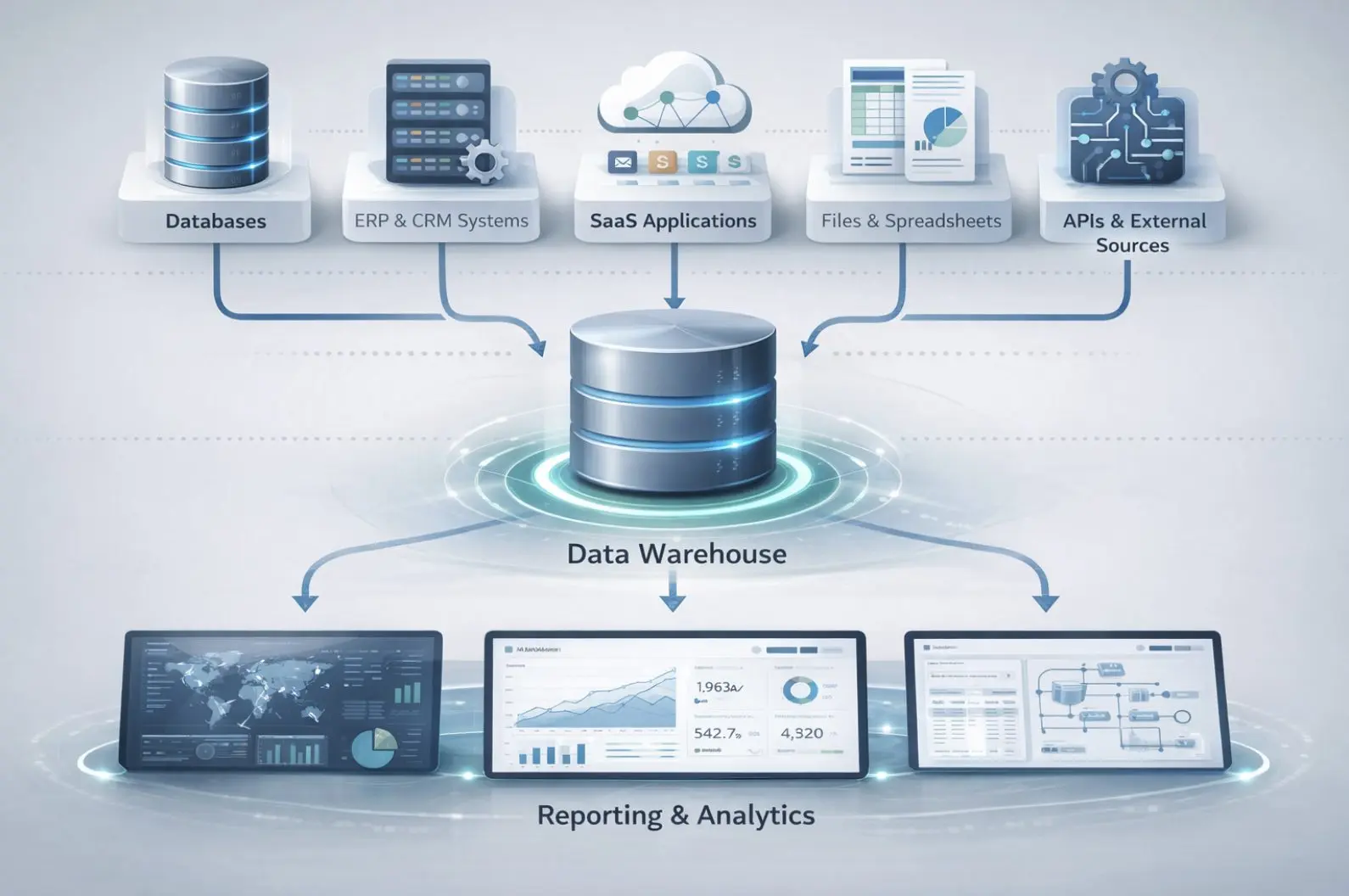
A practical explanation of why growing companies need a data warehouse and how it supports BI dashboards, reporting consistency, and scalable analytics.
Why growing companies need a data warehouse usually becomes clear when reporting starts breaking down. Data is spread across too many systems, reports take too long to prepare, and different teams rely on different versions of the truth. A data warehouse helps create a stronger foundation for scalable reporting and business intelligence.
What Problem a Data Warehouse Solves
Most growing businesses use several operational systems at once. CRM, finance, marketing, operations, inventory, and eCommerce platforms all contain part of the reporting picture. The challenge is that these systems were not designed to provide one shared analytical view.
Without a stronger data foundation, businesses often face:
- inconsistent reporting between departments
- heavy manual effort to combine data
- difficulty tracking performance end-to-end
- limited support for advanced dashboards and trend analysis
What a Data Warehouse Actually Does
A data warehouse is a central reporting layer that stores structured data from different business systems in one place. It does not replace operational tools. It gives the business a more reliable environment for reporting, dashboards, and analytics.
With a warehouse in place, businesses can:
- centralise data from multiple systems
- improve reporting consistency
- support BI dashboards more effectively
- reduce manual consolidation work
- build a reporting model that scales with business growth
When a Business Usually Needs One
A data warehouse becomes more useful when:
- multiple systems need to be reported together
- leadership wants a single performance view
- dashboards depend on reliable cross-system data
- manual spreadsheets are becoming a reporting bottleneck
- reporting needs are becoming more complex over time
Why It Matters for Business Intelligence
A data warehouse is often the foundation of a stronger BI environment. Without it, dashboards may still rely on inconsistent extracts, manual workarounds, or partial views of the business.
With it, organisations can build:
- more reliable KPI reporting
- better dashboard performance
- improved data governance
- clearer historical analysis
- a more scalable reporting architecture
Data Warehouse vs Spreadsheets and Ad Hoc Reporting
Spreadsheets are useful for local analysis, but they are not a reliable long-term reporting architecture. A data warehouse gives the business a central model for reporting instead of relying on
fragmented files and manual joins across teams.
Divaaco’s Perspective
At Divaaco, we usually see the value of a data warehouse emerge when reporting needs become broader than one system or one department. The warehouse itself is not the business objective. The real objective is more dependable reporting, stronger dashboarding, and better visibility across the organisation.
Conclusion
A data warehouse helps growing companies build a stronger reporting foundation. When data is centralised and structured properly, business intelligence becomes more reliable, dashboards become
more useful, and reporting becomes easier to scale as part of broader business intelligence services.
Related Reading
If your reporting is still fragmented, read our guide to business intelligence for growing companies and the hidden cost of manual reporting to see why stronger data foundations matter.
If your business is struggling with fragmented data and inconsistent reporting across systems, Divaaco can help you design a stronger BI and data foundation.
Talk to our team